
Most people, when asked when the first touchscreen smartphone was made, immediately think of the iPhone and the year 2007. It’s an understandable assumption, since Apple’s device is the one that truly changed how the world uses mobile technology. But the real answer goes back further, to a quiet release in 1994 that few people remember today. Uncovering when the first touchscreen smartphone was made means stepping past popular memory and into a fascinating, often overlooked chapter of consumer electronics history.
The Real Answer: IBM Simon Personal Communicator
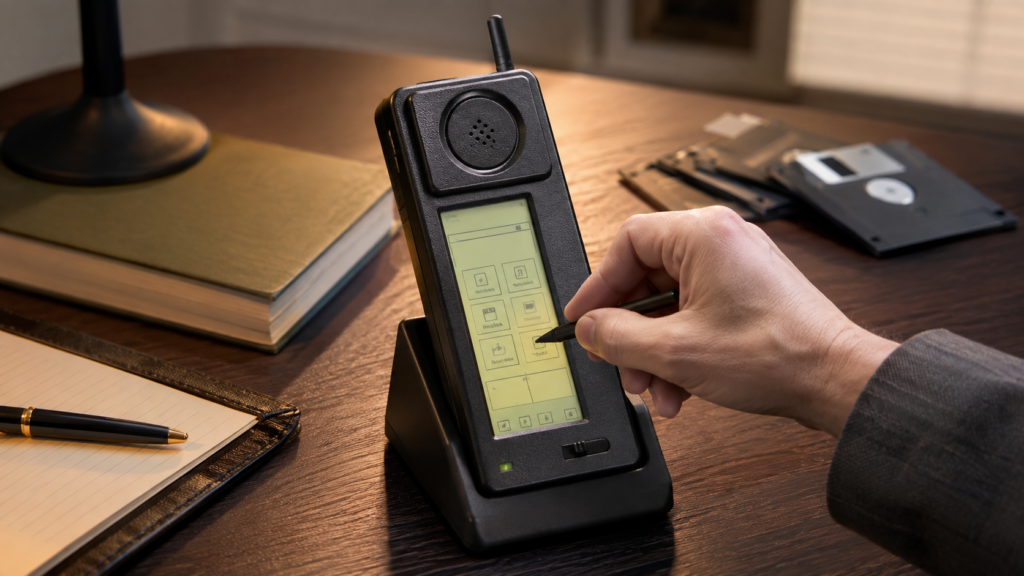
The first touchscreen smartphone was made in 1994, when IBM introduced the Simon Personal Communicator. It was sold through BellSouth and combined a working mobile phone with organiser-style features that, at the time, felt closer to science fiction than a store shelf. This single detail settles the debate for anyone genuinely searching for when the first touchscreen smartphone was made and by whom.
Simon featured a 4.5-inch resistive touchscreen, controlled mainly with a stylus, alongside built-in email, a calendar, an address book, a notepad, and even fax support. It retailed for roughly $899 with a required service agreement, a steep price for 1994. Despite modest sales and a short production run, historians and technology writers consistently cite Simon as the earliest true touchscreen smartphone, making it the definitive starting point for this entire product category.
What Came Before Simon: Early Touchscreen Innovation
Understanding when the first touchscreen smartphone was made also requires looking at the touchscreen technology that made Simon possible in the first place. Long before any smartphone existed, engineer Eric Johnson developed the first documented finger-driven touchscreen, publishing his work in 1965 complete with photographs and technical diagrams. His research proved that a screen could directly register touch input, a concept that seemed experimental at the time but would eventually define modern computing.
A decade later, in 1975, physicist George Samuel Hurst patented the first resistive touchscreen, the same underlying technology IBM would use in Simon nearly twenty years afterwards. Hurst’s invention enabled the conversion of pressure applied to a screen’s surface into precise digital input, solving a technical challenge that earlier touch concepts hadn’t fully addressed. Without this foundational patent, the touchscreen smartphone as we understand it may have taken a very different, and likely much later, path to market.
The Multi-Touch Breakthrough at the University of Toronto
While resistive technology matured through the 1970s, a separate and equally important development was happening in academic research. In 1982, Nimish Mehta built the first human-controlled multi-touch device at the University of Toronto, using a camera positioned beneath a translucent tablet to detect multiple points of contact simultaneously. This was a significant departure from single-touch, stylus-only systems and hinted at interaction methods that wouldn’t become mainstream for another twenty-five years.
Around this same period, computer artist Myron Krueger was experimenting with gesture-based and touch-responsive art installations, pushing the boundaries of how people could physically interact with digital systems. While Simon itself never used multi-touch capability, this parallel line of research quietly laid the groundwork for the capacitive, finger-friendly touchscreens that would eventually appear on smartphones released well into the 2000s and beyond.
Inside the IBM Simon: A Genuine Engineering Leap
The IBM Simon wasn’t a simple mobile phone with a screen attached as an afterthought; it was purpose-built as a hybrid communication and organiser device. Its touchscreen keyboard completely replaced the physical buttons found on nearly every other phone at the time, a genuinely bold design decision for 1994. Paired with calling functionality and productivity tools such as a calendar and a notepad, Simon effectively created the smartphone category before the word “smartphone” had entered everyday vocabulary.
Still, Simon had clear limitations that kept it from mainstream success. Battery life rarely lasted beyond an hour of continuous talk time; the device itself was large and heavy compared to phones of the era; and no software ecosystem allowed users to add new applications. Every function came pre-installed at the factory. These practical shortcomings, combined with its high retail price, meant Simon remained a commercial footnote rather than a mass-market breakthrough.
From Simon to the Smartphones We Know Today
Following Simon’s brief run on the market, touchscreen mobile devices continued to develop steadily throughout the late 1990s and early 2000s. Products like the Palm Treo and various early Windows Mobile devices carried the touchscreen-and-organiser concept forward, gradually introducing colour displays, faster processors, and basic internet browsing, though most still depended on stylus-based input rather than direct finger control.
The true turning point came in 2007, when Apple released the original iPhone, featuring a capacitive touchscreen designed specifically for finger-based multi-touch gestures, and later, in 2008, paired with the App Store. This breakthrough explains why so many people default to the iPhone when asked when the first touchscreen smartphone was made — it modernised and popularised a concept Simon had quietly introduced thirteen years earlier, finally making touchscreen phones a global phenomenon.
Comparing IBM Simon and Modern Smartphones
Placing the IBM Simon next to a current smartphone makes the scale of progress genuinely striking. Simon relied on a resistive, stylus-operated screen, offered no app marketplace, suffered from poor battery performance, and could only run the software IBM had preloaded. Today’s smartphones use responsive capacitive multi-touch displays, support millions of downloadable applications, and typically deliver a full day of battery life alongside constant, always-on connectivity.
Even with these enormous differences, the fundamental concept connecting both devices remains the same: a compact, pocketable device that combines calling, computing, and direct touch interaction into a single tool. Recognising this unbroken thread matters for anyone researching when the first touchscreen smartphone was made, because it reframes the story as a gradual evolution rather than one isolated invention arriving out of nowhere.
Why This History Still Matters Today
Tracing this full timeline offers more than just trivia for tech enthusiasts. It fundamentally reshapes how we understand technological progress and innovation more broadly. Touchscreen smartphones weren’t the product of a single dramatic breakthrough moment; they emerged gradually from decades of overlapping research conducted across universities, corporate laboratories, and independent inventors, each contributing a small but essential piece to the device most people now carry in their pockets every single day.
Read More: https://techustime.co.uk/how-to-optimize-smartphone-battery/
FAQs
What was the first touchscreen smartphone ever made?
The IBM Simon Personal Communicator, released in 1994, is widely recognised as the first touchscreen smartphone, combining phone calling with organiser-style features years before the term “smartphone” existed.
Was the iPhone the first touchscreen phone?
No. The iPhone launched in 2007 and popularised touchscreen smartphones worldwide, but the IBM Simon actually preceded it by thirteen years as the original touchscreen smartphone.
Who invented the first touchscreen?
Eric Johnson is credited with developing the first finger-driven touchscreen, documenting his work in a 1965 article that included supporting photographs and technical diagrams.
When was the first resistive touchscreen invented?
George Samuel Hurst patented the first resistive touchscreen technology in 1975, a system that later became the foundation for the display of the IBM Simon nearly two decades later.
What features did the IBM Simon actually have?
It offered a 4.5-inch resistive touchscreen, stylus-based input, built-in email, calendar, address book, notepad, and fax capability, all packed into one compact device.
Why isn’t the IBM Simon more widely known today?
Its short battery life, high retail price, bulky design, and limited production run kept it from reaching mainstream popularity, despite its genuinely groundbreaking role in mobile history.
Conclusion
So, when was the first touchscreen smartphone made? The most accurate answer is 1994, marked by the release of the IBM Simon Personal Communicator. Yet that milestone sits atop a much longer and richer timeline: Eric Johnson’s 1965 touchscreen research, Hurst’s 1975 resistive patent, and Mehta’s 1982 multi-touch experiments all made Simon possible, while the iPhone later refined and popularised the concept starting in 2007. Together, these milestones paint a complete and fascinating picture of how modern mobile technology truly came to be.