
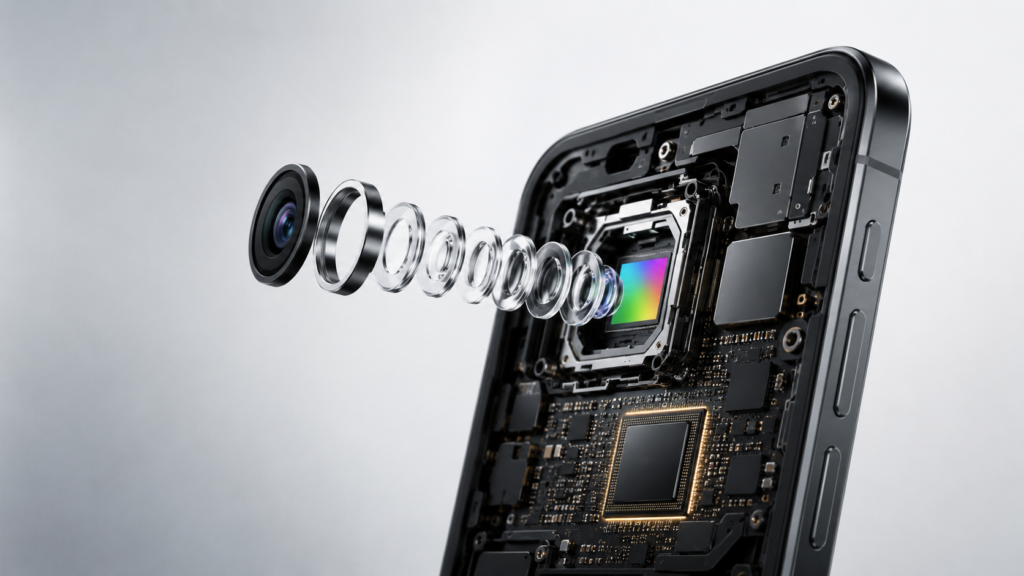

Every time you tap the shutter button, a small piece of engineering happens in a fraction of a second. Understanding how does a smartphone camera work helps you appreciate why your photos look the way they do, and it can even help you take better ones. This guide walks through the entire process, from the glass on the back of your phone to the finished image that appears on your screen moments later.
Smartphones have quietly replaced traditional point-and-shoot cameras for most people, and in many everyday situations, they now produce results that rival those of dedicated cameras. Yet very few users actually know what happens between pressing the shutter and seeing a finished photograph appear. By the end of this article, you’ll understand exactly how does a smartphone camera work, step by step, and why the technology inside your pocket is more advanced than it looks.
The Basic Anatomy of a Smartphone Camera
Despite being squeezed into a device just a few millimetres thick, a smartphone camera contains the same essential building blocks found in professional cameras. These include the lens, aperture, image sensor, image signal processor, autofocus system, and flash. Each of these components plays a specific role, and together they form a coordinated system that captures, processes, and refines an image in real time.
Compared to a DSLR or mirrorless camera, a smartphone camera simplifies many of the mechanical parts. There is no moving mirror, no interchangeable lens mount, and often very limited physical aperture adjustment. Because of these hardware limitations, smartphones rely heavily on software to fill the gaps. This is one of the biggest reasons computational processing has become such a central part of how does a smartphone camera work in modern devices.
How Light Enters: The Lens and Aperture
The lens is the very first component that light touches, and its job sounds simple but is technically demanding: gather incoming light and focus it precisely onto the sensor positioned behind it. Most smartphone lenses are built from several tiny glass or plastic elements stacked closely together, each treated with special coatings designed to reduce glare, ghosting, and unwanted lens flare in bright or backlit conditions.
Aperture size, expressed as an f-stop number, controls exactly how much light reaches the sensor at any given moment. Many phones use a fixed aperture, though some premium models now offer variable apertures for greater creative flexibility. A wider aperture, indicated by a lower f-number, lets in more light, which is especially valuable in low-light photography and for creating a soft, blurred background behind a subject.
Autofocus systems are just as important as the lens itself. Most smartphones rely on phase-detection autofocus, contrast detection, or laser-assisted focusing to lock onto a subject almost instantly. This speed matters enormously when photographing moving subjects, changing lighting, or spontaneous moments where there isn’t time to focus manually before the shot is gone.
Capturing Light: The Image Sensor Explained
Once light passes through the lens, it reaches the image sensor, widely considered the true heart of any smartphone camera. Nearly every modern phone uses a CMOS sensor, which converts incoming light into an electrical signal that can then be translated into usable digital image data. This conversion process happens almost instantaneously, allowing you to see a live preview before you even press the shutter.
Megapixel counts often dominate marketing conversations, but they only tell part of the story. Pixel size and overall sensor size matter just as much, since larger individual pixels can capture more light in a single exposure. This explains why two phones with identical megapixel counts can produce dramatically different image quality, particularly in dim rooms, evening settings, or nighttime environments.
Colour capture occurs through a Bayer filter, a repeating mosaic pattern of red, green, and blue subpixels layered directly over the sensor surface. Through a process known as demosaicing, the camera reconstructs complete colour information from this pattern, transforming raw light data into the vibrant, accurately colored photograph you eventually see on your screen.
Processing the Image: The Role of the Processor
After the sensor finishes capturing raw light data, the image signal processor takes over almost immediately. It handles noise reduction, sharpening, white balance correction, and exposure adjustments, completing all of this work within milliseconds and well before the image preview even appears on your display. This rapid processing is a major part of how does a smartphone camera work so effectively in changing conditions.
This is also where computational photography enters the picture in a meaningful way. Features like HDR, Night Mode, and Portrait Mode all rely on the processor to combine multiple exposures or analyse depth information to produce a final image that goes far beyond what the raw sensor data alone could ever achieve.
Artificial intelligence has become deeply woven into this entire pipeline. Scene detection automatically recognises food, landscapes, text, or faces and adjusts camera settings accordingly, without any user input. AI-driven skin smoothing, sky enhancement, and subject isolation all happen in real time, proving that software has become just as critical to image quality as the physical hardware itself.
Why Phones Have Multiple Cameras
Most modern smartphones now include two, three, or even four rear lenses, each serving a distinct purpose. A main wide lens typically handles everyday photography; an ultra-wide lens captures expansive landscapes or large group shots; a telephoto lens enables genuine optical zoom; and a dedicated macro lens focuses on extreme close-up detail that other lenses cannot capture clearly.
The phone’s internal software blends data from these different lenses seamlessly, especially during zoom transitions where the camera switches between lenses without the user noticing. This is also where the difference between optical zoom, digital zoom, and hybrid zoom becomes genuinely important, since optical zoom preserves image quality through physical lens elements, while digital zoom simply crops and enlarges the image, often sacrificing sharpness in the process.
From Sensor to Screen: The Full Image Pipeline
To fully understand how does a smartphone camera work, it helps to walk through the entire image pipeline from beginning to end. First, light enters through the lens. Second, that light is focused with precision directly onto the image sensor positioned just behind it, ready to begin the conversion process into usable data.
Third, the sensor converts this incoming light into raw electrical signals. Fourth, the image processor transforms this raw data into a viewable photograph, correcting colour balance, exposure, and contrast along the way—fifth, computational software layers in additional enhancements such as HDR blending or advanced noise reduction. Finally, the finished image is compressed into a JPEG or HEIC file format and saved directly to your gallery, ready to view, edit, or share instantly.
Common Factors That Affect Camera Quality
Several key variables determine how well a smartphone camera performs in real-world conditions. Sensor size and individual pixel size both play a major role in overall image quality, as does aperture size, which directly controls how much light reaches the sensor when shooting indoors or after sunset.
Software quality is equally influential, and arguably underrated. Two phones with nearly identical hardware specifications can still produce noticeably different results depending on how well their processing algorithms handle noise reduction, colour accuracy, and dynamic range. Lighting conditions remain the single biggest overall challenge, which is exactly why low-light performance is so frequently used as a key benchmark when comparing different smartphone cameras side by side.
Smartphone Cameras vs Traditional Cameras
Physically speaking, smartphone image sensors are far smaller than those in DSLR or mirrorless cameras, and this size difference naturally limits how much light they can gather in a single shot. Computational photography largely exists to compensate for this physical gap, using intelligent software techniques to achieve results that would otherwise require significantly larger and bulkier camera hardware.
That said, smartphones still hold clear advantages in convenience, speed, and shareability, since you can shoot, edit, and publish a photo online within seconds of taking it. Dedicated cameras continue to hold the advantage in situations that demand full manual control, extreme low-light performance, or large-format print quality, which means each tool remains genuinely well-suited to different needs and types of photographers.
Read More: https://techustime.co.uk/logitech-unifying-software-download/
FAQs
How does a smartphone camera work in simple terms?
Light enters through the lens, strikes the image sensor, and gets converted into digital data. The phone’s processor then refines that data using software enhancements, producing a finished photograph within a fraction of a second, all without any manual input required from the user.
What is the difference between a smartphone camera lens and sensor?
The lens gathers and focuses incoming light onto a precise point. At the same time, the sensor sits directly behind it. It converts that focused light into an electrical signal, which is then translated into the digital image data your phone uses to build the final photograph.
Why do more megapixels not always mean better photos?
Megapixels measure resolution, not overall image quality. Pixel size, sensor size, and processing power often matter far more, especially in low-light situations, since larger pixels can capture more light per shot than smaller, more tightly packed ones.
What does the image processor do in a phone camera?
The processor handles real-time tasks such as noise reduction, white balance correction, exposure adjustment, and HDR blending, converting raw sensor data into a polished, ready-to-share photograph within milliseconds of the shutter being pressed.
Why do smartphones have multiple camera lenses?
Multiple lenses allow a single phone to cover different focal lengths and use cases at once, including wide-angle shots for everyday photography, ultra-wide shots for landscapes, telephoto for genuine zoom, and macro lenses for extreme close-up detail work.
Can a smartphone camera match a DSLR camera?
Smartphones excel in convenience, speed, and computational enhancements, but DSLRs still lead in areas like manual control, larger sensor size, and performance in extreme low-light conditions or for professional print-quality photography, where raw hardware capability matters most.
What is computational photography?
Computational photography uses software and artificial intelligence to enhance images well beyond what raw camera hardware alone could achieve, powering popular features like Night Mode, HDR, and Portrait Mode that many smartphone users rely on daily.
Conclusion
So, how does a smartphone camera work? It ultimately comes down to a tightly coordinated system working together: a lens that gathers incoming light, a sensor that converts it into usable data, and a processor that transforms that raw data into a finished, polished photograph. Multiple lenses and advanced computational photography techniques push this entire process even further, gradually closing the long-standing gap between smartphones and traditional dedicated cameras.
Ultimately, smartphone cameras succeed not because of hardware alone, but because of the intelligent software constantly working behind the scenes at every single stage of the process. The next time you casually snap a photo, you’ll understand exactly what’s happening inside that small lens, and why it genuinely matters when you’re comparing phones or choosing your next upgrade.